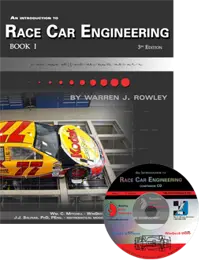
Book 1 was first published in 2002 and sold through William C. Mitchell’s office in Mooresville, NC, up until Bill’s death in 2014. At that time, it was decided that we would stop selling Book 1.
Warren Rowley Note: The truth is that, even though the book sold beyond my wildest dreams, I wanted nothing to do with the actual day-to-day work of selling the book myself, because I would be useless at that job. In fact, until Mr. Mitchell’s passing, Cindy Didero, Bill’s Executive secretary and office manager, had been handling all the book sales work (Thank you, Cindy).
An Introduction to Race Car Engineering – Book 1 has three primary components:
– An introduction to the basics of racing tires.
– A thorough analysis of suspension kinematics, which included a free version of Bill Mitchell’s WinGeo3 software.
– An extensive look at the basics of vehicle dynamics through text and a series of Excel models. The math used in the Excel models was masterfully developed and explained in Chapter 15 by Dr. Juan J. Salinas.
All Book 1 software can be downloaded under Download Software Book 1. However, in the case of WinGeo3, rather than the restricted model that came with Book 1, the user can now download a free, unrestricted professional version of WinGeo3, which, at the time of Bill’s death, was selling for approximately $3500.00 USD. This software allows the user to run WinGeo3 with on-track data. Once the track data is loaded, WinGeo3 can record every kinematic motion at 1 Hz.
Thank you, Cindy Didero,for allowing users to download Bill’s software!
Click here to download: Book 1 Chapter Contents
Introduction
Chapter 1 – Some Basic Truths
The Tire
Chapter 2 – Tires: Part One – Design and Performance Parameters
Chapter 3 – Tires: Part Two
A Race Engineer’s Look at Tire Performance
Chapter 4 – Part Three – A First Look at Tire Data
The Kinematic
Chapter 5 – WinGeo3 – Wm. C. Mitchell Software
Chapter 6 – Independent Suspension – A Kinematic Overview
Chapter 7 – Steering Geometry – Kinematics and Definitions
Chapter 8 – Live Axle – Rear Suspension Kinematics
Chapter 9 – Truck Arm – Rear Suspension Kinematics
Chapter 10 – Springs and Motion Ratios
Chapter 11 – Anti Roll Bars and Motion Ratios
Chapter 12 – Tires as Springs
Chapter 13 – Static Loads Mass Centers of Gravity
The Dynamics
Chapter 14 – Load Transfer 101 – The First Basic Look
Chapter 15 – A Mathematical Look at Vehicle Dynamics
Chapter 16 – Load Transfer – Asymmetrical Load Transfer
Chapter 17 – Open Wheel – Inertial and Aerodynamic Loading
Chapter 18 – Stagger and Stagger Torque
Chapter 19 – Developing the Tire Maps
Chapter 20 – Dynamic Simulation Wan31B: Part One
Chapter 21 – Dynamic Simulation – Part Two – Formula/Aero
Click here to download Book 1 Examples
Book 1 is divided into three primary components·
– The basics of tire performance.
– An extensive look at suspension kinematics in consort with Wm. C. Mitchell’s WinGeo3. These chapters cover virtually every component and theory of use for all types of modern race cars. The Kinematic chapters carefully walk the user through each step of using WinGeo3.
– The basics of vehicle dynamic performance. These chapters cover the base setup and the resultant on-track performance of various oval-track and circuit-type cars. The authors have developed a series of Excel-based software tools to help explain each component of the book’s vehicle dynamics examples and to allow users to further expand on the book’s initial theories and examples. All the math used in the book’s vehicle dynamic chapters is carefully developed and explained in Chapter 15.
Click here to go to the Downloads page.
Excel files with macros, for security reasons, Microsoft requires users to reset their security settings to run macros. This can be a real pain in the rectatorinitamus for both the authors and the users.
To be sure the Excel files do not contain malware, the user should download the signed files.
Note: All 53 Book 2 Excel files are more complex in nature, and as a result, all Book 2 Excel software components are signed.
For directions on how to properly open and allow macros to run files with .xlsx and .xlsm extensions, please go to the Downloading Excel Files Containing Macros page.